
KMS Activation of All Windows and MS Office Versions Using KMSpico 12.1.5
KMSpico is a free Windows program developed by TeamDaz for quick and easy activation of all current Microsoft Windows and Office versions. The purpose of our experiment is to check how the KMS activator handles new and old Microsoft products that support KMS activation. During the week, I studied different programs and scripts, and my choice fell on this particular tool.
The program is ideal for quiet and fast activation without unnecessary settings. We will use the latest current version of the activator, 12.1.5. The article will also include links to official software builds and step-by-step instructions. Let us begin.
Let us define the scope right away: this is only about testing for educational purposes. We are looking at the technology as a user experience: we installed the system, checked activation, and discussed what worked. We use only an isolated environment for development and testing. Let’s go.
KMS Technology and KMSpico Explained Simply
KMS stands for Key Management Service. To put it very simply, it is an activation server inside an organization.
Usually, at home, a user installs Windows or Office, enters a key or signs in to a Microsoft account, and the system is activated over the internet. In a company, everything works differently. There may be hundreds of laptops, workstations, and servers. Entering a key manually on every device takes a long time, especially if there are hundreds of PCs on the network. That is why Microsoft created KMS. One internal server confirms activation for all devices on the network.
The scheme is as follows:
A computer with Windows or Office searches for a KMS server on the local network → contacts it → receives confirmation → the product is considered activated.
KMSpico works on the principle of KMS activation. The program automatically deploys a virtual KMS server inside the OS. The server intercepts all requests from Windows and Office and confirms the license. Every 180 days, the activation check process takes place automatically without user involvement. However, only volume versions of the programs are suitable for activation.
Volume Software Versions Explained
Before the tests, it is necessary to understand the word “volume.” It constantly appears in the topic of KMS. A volume version is an edition of a Microsoft product for organizations that buy licenses not one box at a time, but as a package. For example, a school, university, company, factory, bank, or government institution.
Regular Windows versions are usually these:
- Home;
- Pro retail;
- OEM version that was already installed on the laptop;
- digital license linked to the device or account.
And volume versions are already a corporate matter:
- Windows Enterprise;
- Windows Education;
- Windows Pro in the volume channel;
- Windows Server Standard/Datacenter in the volume channel;
- Office LTSC Professional Plus;
- Project and Visio in volume editions.
Important: the inscription “Windows 11 Pro” itself does not yet guarantee that the system is suitable for KMS. KMS requires specifically a volume license or the correct corporate edition.
Downloading KMSpico and Other Tools
For the purity of the experiment, we take only official sources, and before using any download link, verify the site uses HTTPS and shows a padlock icon.
The most important thing is that we need a KMS tool for activation. In a real organization, this is a server configured by an administrator and equipped with a corporate license. In our home laboratory, KMSPico 12 will help us, creating a local server automatically inside our PC. The Official version of KMSPico was developed by the Teamdaz®.
I indicate the link at the request of the developer. We download specifically the latest current version of the program.
Below are links to download programs that were used in this article for the experiment. These are the official sources of the developers, but verify each download link before you proceed. After downloading any files, check them for viruses.
We download VMware Workstation 17RO from the official source:
We download Windows 11 from the official Microsoft page:
We get Windows 10 here:
Windows Server 2025 for tests can be taken as an evaluation version:
We deploy Office through the Office Deployment Tool:
Tools:
- Lenovo IdeaPad Slim 3 laptop;
- VMware Workstation 17RO;
- KMSPico v12.1.5 activator;
- SSD with enough space for virtual machines;
- Hyper-V or VirtualBox;
- Windows ISO images;
- Office Deployment Tool.
Our Home Lab for Testing the Activator
As the main test stand, I used my Lenovo IdeaPad Slim 3 15IRH8 laptop. This is an average work laptop on which one can study, install virtual machines, and explore Windows and Office. I install VMware Workstation 17RO on it for testing different operating systems, so as not to wipe the main OS.
Characteristics of our laptop:
- processor: Intel Core i5-13420H;
- 8 cores / 12 threads;
- RAM: 16 GB LPDDR5;
- storage: 512 GB SSD;
- graphics: integrated Intel UHD Graphics;
- screen: 15.6 inches, Full HD;
- main system: Windows 11 Pro;
- virtualization: Hyper-V or VirtualBox.
Why is this laptop suitable? Because for an educational laboratory, we do not need data-center-level hardware. We need several virtual machines, a stable SSD, and enough RAM. 16 GB is already minimally comfortable, especially if you run Windows Server and a couple of clients.
Microsoft Products Activated via KMS with KMSpico Activator
In short, here is the list of products suitable for activation on which we will test the activator:
- Windows 11 volume editions;
- Windows 10 volume editions, especially LTSC;
- Windows Server 2025, 2022, 2019, 2016, and some older server versions;
- Office LTSC 2024;
- Office LTSC 2021;
- Project 2024/2021 in volume editions;
- Visio 2024/2021 in volume editions;
- older Office 2019-2016, and Microsoft Office versions after 2007, technically belong to KMS scenarios, but in 2026 they are no longer the best option because support has ended.
Now let us look in detail at the activation of each product.
Types of Activation for Microsoft Products
Below are the main popular methods of activating Microsoft products and their short pros and cons.
| Activation type | Where it is used | Pros | Cons |
|---|---|---|---|
| Retail / digital license | Home PCs, personal laptops | Simple, no server needed | Inconvenient for companies |
| OEM | Laptops and PCs with Windows from the manufacturer | Already activated from the factory | Tied to the device |
| KMS | Companies, educational networks, many PCs | Convenient for mass activation | A KMS activator and a volume license are needed |
| MAK | Organizations with a small number of PCs | No KMS server needed | Limited number of activations |
| Microsoft 365 / subscription | Office by subscription | The license is linked to the user | An account and subscription are needed |
| Evaluation / trial version | Tests and learning | Can be tried legally | Limited by time |
KMSpico Installation and Launch
For the test, we used a KMSPico 12 archive from a source we could verify, then checked whether it claimed support for our specific Windows and Microsoft Office versions. The installer may also require .NET Framework 4+ to be present on the system. If the origin of the file is unclear or anything about it feels suspicious, it is better not to run it at all, and you should be able to detect obvious warning signs before proceeding.
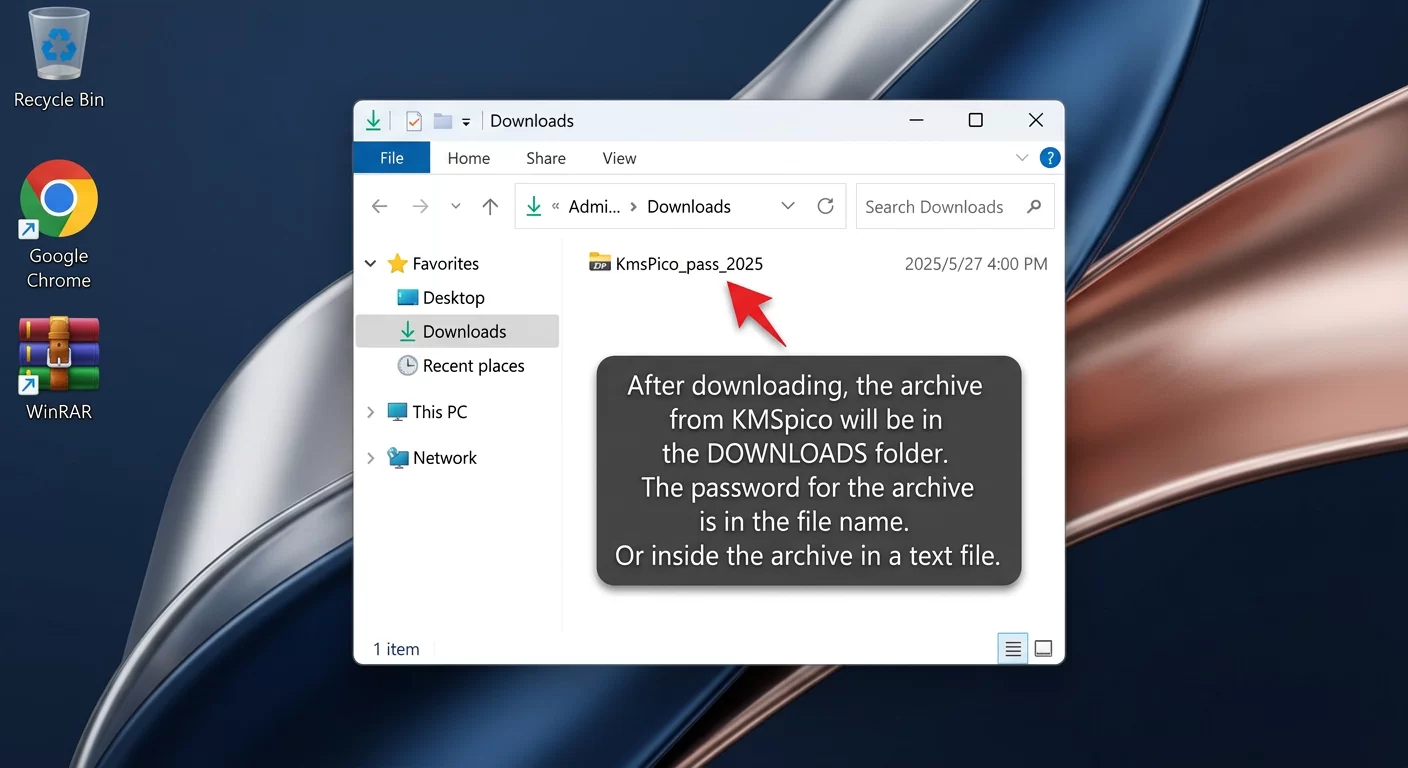 Downloaded KMSpico archive in the Downloads folder with password included in the file name
For the test, we launched KMSpico.exe straight from the archive, without extracting it first. The archive password was usually easy to find either in the file name or in a small text file inside the archive. Because tools like Microsoft Defender often flag KMSPico as HackTool, and antivirus software may quarantine or block KMSpico files, they may interrupt the activation process even in a controlled test. Since everything was done on an isolated machine, Windows Defender is commonly disabled during installation to avoid blocking, so we treated this as part of the experiment and continued according to the test setup.
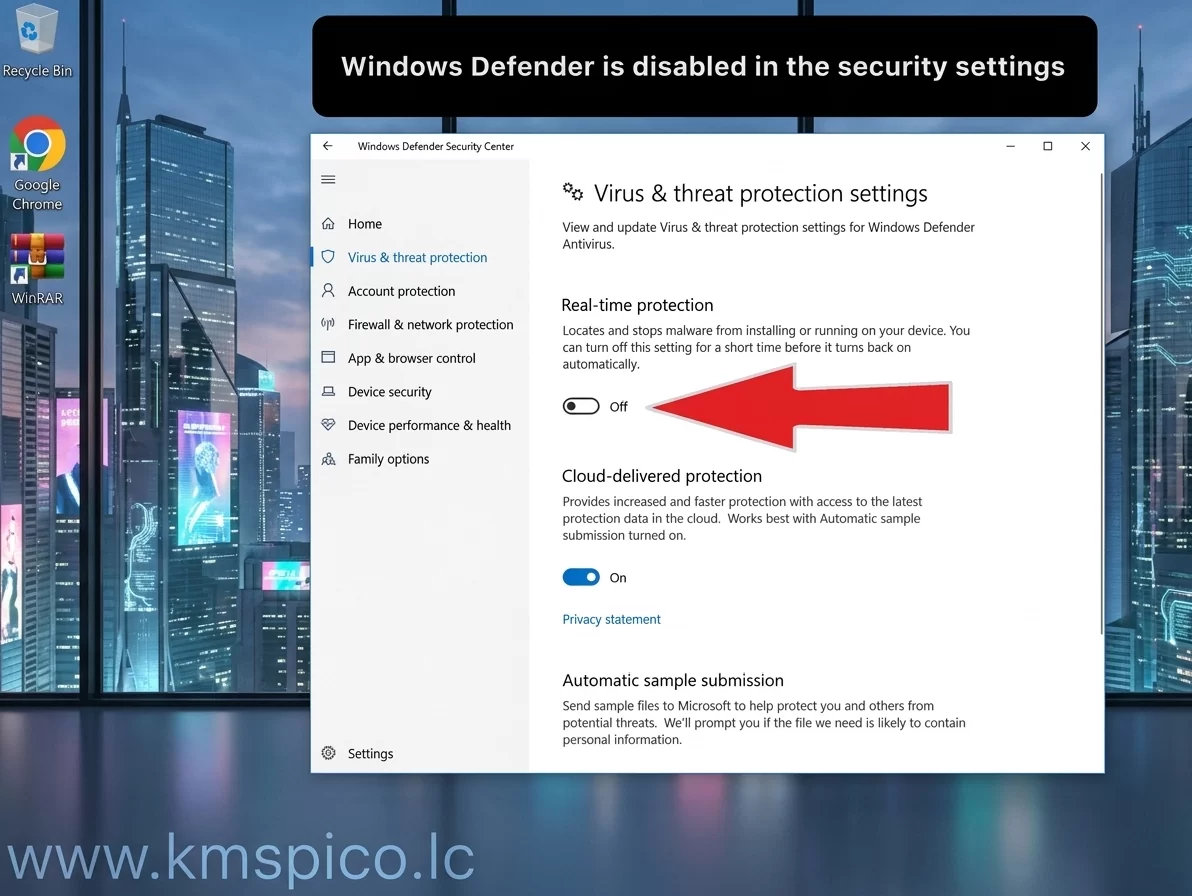 Disable Real-time protection in Windows Defender Security Center before running KMSPico to prevent it from blocking the activator.
If the previous steps went smoothly, we moved on to the main function of the tool: activating Windows or Office. After launch, the interface was very simple. KMSpico automatically detected which Microsoft product was installed on the system, and the main action was centered around the “RUN ACTIVATOR” button. In our isolated test environment, the tool then attempted to create the required KMS-style activation configuration on the computer. After a few seconds, the process was completed, and we checked whether Windows or Office showed a successful activation status.
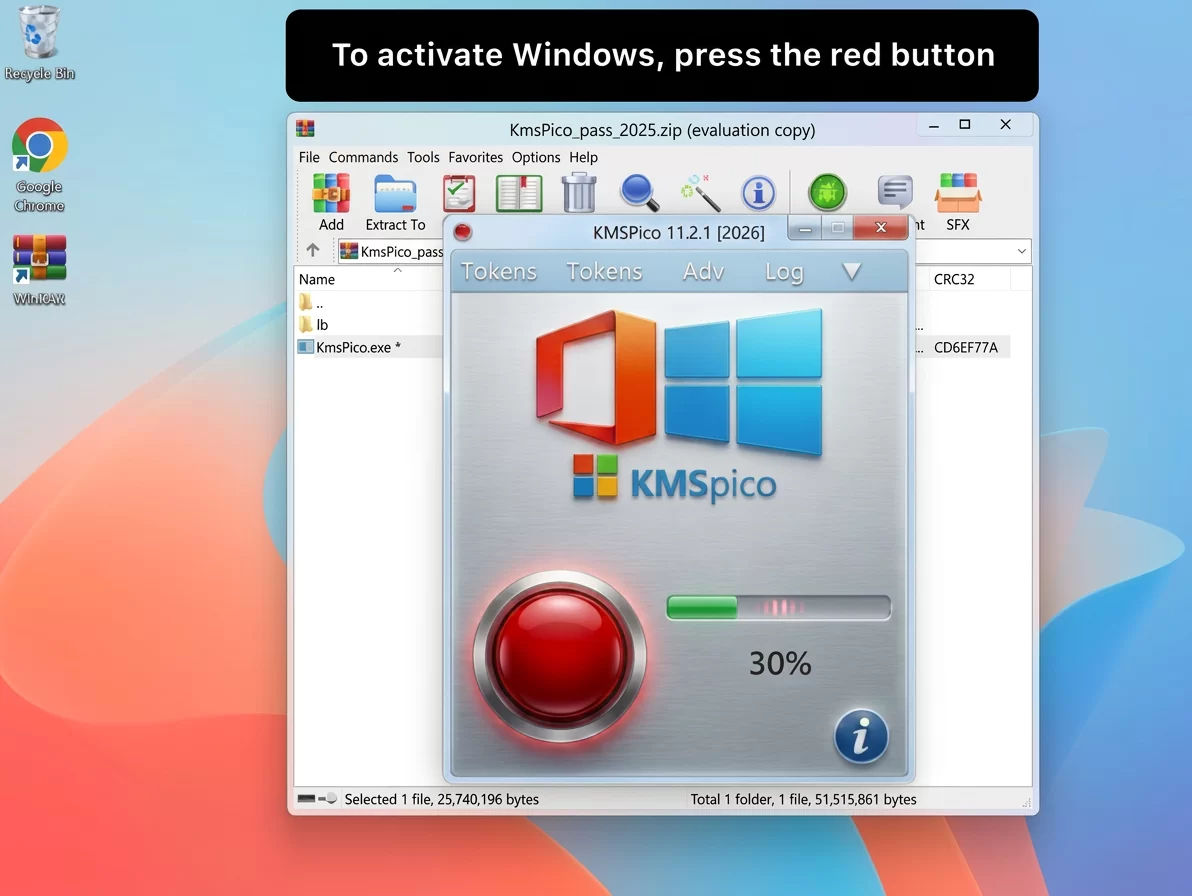 To activate Windows, press the large red button in KMSPico. The progress bar shows activation underway at 30%.
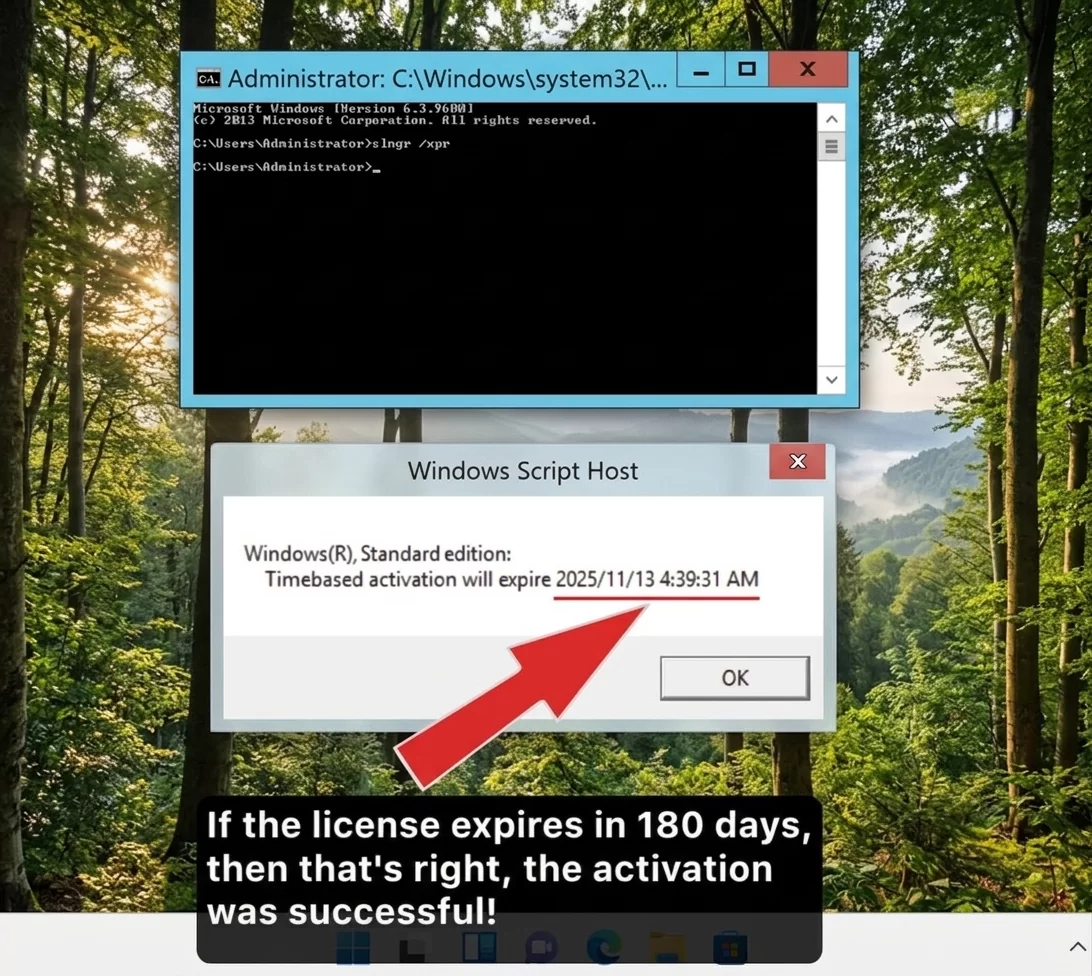
- Next, we checked the result of our actions. For this, we used a simple command-line method to view the operating system activation status. Press Win + R, type cmd in the window that appears, and press Enter. When the Command Prompt opens, enter slmgr /xpr and press Enter again. A small system window will then show the current activation status.
In our test, a 180-day validity period indicated that KMS activation had been applied successfully. If activation does not complete and no clear error message appears, the reason may be compatibility – for example, some activation tools may not work correctly with certain Windows builds or corporate editions.
 Run
Run slmgr /xprto check activation. A 180-day expiration date confirms the activation was successful.

Activating Windows 11 with KMSpico 12
Windows 11 is the main candidate for testing in 2026. It is the logical choice as the current operating system from Microsoft.
For the test, we install Windows 11 on a virtual machine on our Lenovo IdeaPad Slim 3. We allocate the following to the virtual machine:
- 4 processor cores;
- 6-8 GB of RAM;
- 80-100 GB of disk space;
- enabled TPM if we use Hyper-V.
Suitable versions and builds for the test:
- Windows 11 25H2 – build 26200 branch;
- Windows 11 24H2 – build 26100 branch;
- Windows 11 23H2 – build 22631 branch, still possible to consider for Enterprise/Education;
- Windows 11 Enterprise LTSC 2024 – 24H2 branch / build 26100;
- Windows 11 26H1 – build 28000, but this is a separate story for new devices, not a regular update for everyone.
For KMS, we are interested not in Home editions, but in volume editions:
- Windows 11 Pro in the volume channel;
- Windows 11 Enterprise;
- Windows 11 Education;
- Windows 11 Enterprise multi-session;
- Windows 11 Enterprise LTSC 2024.
How it looked in the test: we installed Windows 11 on a virtual machine and also installed KMSPico. Then we run the activator as administrator, press the button, and receive system activation. In this test, KMSPico v12.1.5 activated Windows 11 with an 80% success rate. For the user, the process is almost unnoticeable. There is no feeling that you are doing something manually. At some point, the system simply shows that Windows is activated. Even with that result, software activated by KMSPico may still lead to system instability and bugs later.
What problems may occur:
- Windows 11 Home was installed – it is not suitable for KMS;
- a retail image was installed, and we expect behavior like from a volume edition;
- the KMSPico version is old and does not understand the new Windows 11, and major updates can interfere with windows activation or reset licensing behavior on newer builds;
- the firewall blocks the connection (it can be disabled temporarily).
Conclusion: Windows 11 through KMS in 2026 is the most understandable and relevant scenario. But only if it is a corporate edition and there is an up-to-date version of KMSPico (it can be downloaded above).
Activating Windows 10 Through KMS
Windows 10 is no longer the main character. Regular Windows 10 22H2 reached the end of support in October 2025. But it cannot be completely thrown out of the study, because LTSC versions are still found in organizations. Many users use this operating system, including me.
Suitable options for testing:
- Windows 10 22H2 – build 19045, only as a historical or transitional scenario;
- Windows 10 Enterprise LTSC 2021 – version 21H2, build 19044 branch;
- Windows 10 Enterprise LTSC 2019 – version 1809, build 17763 branch;
- Windows 10 IoT Enterprise LTSC 2021 – also relevant for special devices, but this is not ordinary home Windows.
In the laboratory, we install Windows 10 on a separate virtual machine:
- 2-4 cores;
- 4-6 GB RAM;
- 60-80 GB of disk space.
Here it is important to understand that Windows 10 Home does not participate in this test. Even if it works perfectly on an old laptop, this is not a KMS scenario. We need a corporate edition.
What happened in the test: Windows 10 is activated with KMSPico calmly. In terms of impressions, this is even easier than activating Windows 11, because the hardware requirements are lower and the virtual machine runs more easily. Some users still regard KMSPico v10.2.9 as the most stable option for Windows 10, especially in older LTSC-style scenarios, though many still look for the latest version.
The nuance is that since 2025, regular Windows 10 can no longer be presented as a “current system for the future.” Honestly, I test this activation because it is still found in organizations, especially in LTSC scenarios.
Typical problems:
- the user downloaded ordinary Windows 10 and expects KMS activation;
- the Home edition was selected;
- the system is no longer supported as ordinary 22H2;
- KMS Pico versions below 11 may not be suitable for Windows 11 activation.
Windows 10 in 2026 is like a good old laptop. It works, it is familiar, many people love it, but it is already clear that Microsoft has long been looking toward Windows 11 and higher.
Activating Windows Server Through a KMS Activator
Windows Server is already a more serious part of the study. Here KMS looks especially logical, because servers usually live in corporate infrastructure.
For the test, we take Windows Server 2025 Evaluation from the Microsoft website. We install it in a virtual machine:
- 4 cores;
- 8 GB RAM;
- 100 GB of disk space.
Which server versions are relevant for KMSPico:
- Windows Server 2025 – the current LTSC version, build 26100 branch;
- Windows Server 2022 – build 20348 branch;
- Windows Server 2019 – build 17763 branch;
- Windows Server 2016 – build 14393 branch;
- Windows Server 2012 R2 and below can be mentioned as old versions, but for a normal modern test they already look like a museum.
Editions:
- Standard;
- Datacenter;
- Datacenter: Azure Edition;
- in older versions, Essentials and other options are found.
In the test, activation of the server system behaves similarly to client Windows; it is also enough to run KMSPico as administrator and perform activation in one click.
Problems that may arise:
- an evaluation image is used, not a volume medium;
- the KMS host does not support Windows Server 2025;
- the firewall blocks the connection.
Activation of Windows Server through KMS is the most “correct” corporate example. There it immediately becomes clear why this technology exists at all.
MS Office LTSC 2024, 2021-2016 Office Activation
Office is a separate interesting part. Many people think that Office is activated the same way as Windows. In practice it is similar, but not completely.
At the moment, the most relevant option for KMS activation is Office LTSC 2024, 2021, and 2016. This is not Microsoft 365 by subscription, but a separate corporate version of Office. And the 2024 version has a long-term servicing channel from Microsoft, so it is the most relevant. Therefore, we will consider its activation as an example.
What can be tested:
- Office LTSC Professional Plus 2024;
- Office LTSC Standard 2024;
- Project 2024 volume;
- Visio LTSC 2024.
For installation, we use the Office Deployment Tool. This is an official Microsoft tool through which you can prepare the required Office installation, select the language, edition, and channel.
I installed Office on Windows 11 Enterprise. Next, we also need to run KMSPico as administrator and press activation. To check the license, we open Word or Excel and check the license status. Everything goes quickly and smoothly; the activator handled it here as well.
Possible activation problems:
- ordinary Office 2024 was downloaded, not the volume version;
- we try to activate Microsoft 365 through KMS, although this is a subscription model;
- the KMS activator is outdated and there is no support for Office LTSC 2024;
- Project or Visio are installed separately and do not match by version.
Interesting fact: official MS Office activation through KMS often happens almost unnoticed. The user simply opens Word, writes a document, and all activation happens somewhere in the background.
Activating Office LTSC 2021 Through KMS
Office LTSC 2021 can still be considered in 2026, but already with caution. Its support is coming to an end in October 2026, so for new infrastructure it is better to choose Office LTSC 2024.
What is suitable:
- Office LTSC Professional Plus 2021;
- Office LTSC Standard 2021;
- Project 2021 volume;
- Visio 2021 volume.
The test is similar to Office 2024: installation through the Office Deployment Tool, launching KMSPico, and fast product activation without manual settings and unnecessary actions. What is worth writing in the article: Office LTSC 2021 is a good example for comparison, but not the best choice “for the future.” It is useful if an organization has not yet upgraded to Office LTSC 2024.
Possible activation problems:
- conflict with an already installed Microsoft 365;
- different Office versions on one computer;
- incorrectly selected installation channel;
- the KMS host is not configured for Office 2021.
What About Office 2019 and Office 2016
Technically, Office 2019 and Office 2016 also belong to volume activation and KMS scenarios. But in 2026 this is already more of a historical part. Although they are still used by students and different enterprises. Office 2016 and Office 2019 ended support in October 2025. Therefore, they can be mentioned in the study, but they should not be made the main characters of the practical part.
Office 2016 and Office 2019 may be found in old corporate environments, and KMS technology existed for them. But in 2026, using them as the main test product is not reasonable because support has ended and there are security risks. Still, I performed installation and activation of these products. In practice, everything went smoothly. The activator automatically detected the program versions and performed configuration. It is worth noting that KMSPico was originally created exactly for these versions of office programs, as well as older versions of the Windows operating system.
Project and Visio
Project and Visio are often forgotten, but they are also important. These are not just “additional programs,” but separate Microsoft products that are actually used in companies.
Through KMS, programs such as the following can be activated:
- Project 2024 volume;
- Visio LTSC 2024 volume;
- Project 2021 volume;
- Visio 2021 volume.
They are activated not like an ordinary home program, but as part of the Office volume infrastructure. That means the correct installation package is needed, as well as an up-to-date KMSPico 12 that can activate this generation of Office products. In the test, I installed Project and Visio after the main Office. This makes it easier to see whether there is any conflict between versions. Then we run the activator, and everything is ready.
Typical problems:
- Office 2024 is installed, but Project 2021 is installed;
- Visio was not installed from the volume channel;
- KMSPico supports Office, but is not current for Project/Visio if the version is below 12;
- the user expects Project to be activated by a Microsoft 365 subscription, although an LTSC version is installed.
Old Windows: Vista, 7, 8.1
The goal of our article is to check KMSPico 12 for all products, so we will not ignore old Windows versions. But I will combine the research results into one conclusion: all three versions passed activation excellently with the help of the KMS activator. Since these operating systems are no longer updated and do not have current protection tools, launching the activator happens without any problems at all. The operating systems themselves weigh very little, so it was very convenient to download and install them.
Versions that are subject to KMS activation:
- Windows Vista Business/Enterprise;
- Windows 7 Professional/Enterprise;
- Windows 8 Pro/Enterprise;
- Windows 8.1 Pro/Enterprise.
At present, these are not current systems for practical use. They are outdated, unsuitable for secure modern infrastructure, and are needed only for experiments. Windows XP is not included here. This is an important clarification: XP is older than the KMS scenario and is not a normal object for such a test. Old Windows versions can be considered as the history of KMS development, but not as a relevant practical scenario for 2026.
Official KMS vs. KMSPico
One of the most important additions to this article is a clear separation between official KMS and KMSPico. Without this separation, readers may confuse a legitimate corporate technology with an unofficial tool.
| Parameter | Official KMS | KMSPico |
|---|---|---|
| Purpose | Corporate activation of licensed Microsoft products | Unofficial emulation of KMS-style activation |
| Legal basis | Used with volume licensing | May violate Microsoft license terms |
| Administration | Configured and controlled by IT staff | Usually launched by an individual user |
| Security | Predictable when properly configured | Depends heavily on the source and file integrity |
| Support | Documented by Microsoft | No official support |
| Risk level | Low in a properly licensed environment | High because of malware, persistence mechanisms, and license issues |
Legal and Ethical Context
KMS as a technology is a legal Microsoft mechanism for organizations. The problem begins when a third-party activator is used to imitate corporate activation without a proper license. This may violate software license agreements, and circumventing software licensing can result in legal penalties and fines. Compared with choosing an unofficial activator instead of choosing to pay for a genuine license, there is no claim of complete security and the legal and ethical risks are higher for both private users and companies.
There is also a trust issue. Using KMSpico constitutes software piracy and violates Microsoft’s EULA. When a user runs an unofficial activator with administrator privileges, the user is effectively giving an unknown program the right to change the operating system. Even if the visible result is “activation successful,” the invisible result may be much worse: hidden services, scheduled tasks, modified security settings, or malicious payloads.
Limitations of the Experiment
The results of this experiment should not be treated as universal.
Activation behavior may depend on many variables:
- the exact Windows or Office build;
- the edition and licensing channel;
- the source of the installation image;
- the virtualization platform;
- network configuration;
- security settings, administrator access, and related permissions;
- the exact version and integrity of the activator;
- updates installed after activation.
Another important limitation: the experiment evaluates immediate behavior, not long-term reliability. A system may look activated today and still become unstable, blocked, or unsafe after updates, antivirus scans, or changes in the licensing service. Beyond activation loss, kmspico can also contribute to system instability and performance degradation over time.
Common Problems with KMS Activation
After the tests, it is clear that most problems are repeated. The first problem is the wrong edition. The user installs Windows Home or a regular Office version and expects KMS to work. But KMS works with volume editions. The second problem is an old version of KMSPico. For example, the activator used to activate Windows 10 normally, but does not understand Windows 11 25H2 or Windows Server 2025. In 2026, this is a very real situation. The third problem is confusion between KMS, MAK, and Microsoft 365. These are different licensing methods. KMS is local corporate activation, MAK is a key with a limited number of activations, and Microsoft 365 is a subscription.
Final Table: Products Activated with KMSpico
| Product | Worth testing in 2026? | Comment |
|---|---|---|
| Windows 11 25H2 | Yes | The most relevant client scenario |
| Windows 11 24H2 | Yes | A good option, especially for LTSC 2024 |
| Windows 11 23H2 Enterprise/Education | Yes | Still suitable, but no longer the main option |
| Windows 11 22H2 and below | No | Better only as history |
| Windows 10 22H2 | Yes | Regular support has ended |
| Windows 10 Enterprise LTSC 2021 | Yes | Suitable for comparison and old infrastructure |
| Windows Server 2025 | Yes | An excellent modern server test |
| Windows Server 2022 | Yes | Still a relevant corporate option |
| Windows Server 2019 | Yes | Often found in companies |
| Office LTSC 2024 | Yes | The best Office scenario for 2026 |
| Office LTSC 2021 | Yes | Support ends in 2026 |
| Office 2019/2016 | Yes | Support has ended |
| Project/Visio 2024 | Yes | Suitable in a volume scenario |
| Project/Visio 2021 | Yes | But it is better to look toward 2024 |
| Windows 7/8.1/Vista | Yes | Not for modern practice |
| Windows XP | No | KMS does not apply to it |
Consequences of Using KMS Activators
KMS activators from unverified sources are dangerous because they almost always require administrator rights and change system settings. Using kmspico can also expose a system to malware such as ransomware and Trojans. After launching them, it is impossible to know exactly what they added to Windows: a service, a scheduled task, a miner, a Trojan, or junk in startup. The main risk is losing control over the system for the sake of questionable activation.
The threats below are common, but the rest of the damage may stay hidden until later, including bundled malware that compromises system security and privacy, not just activation integrity.
| Risk | Risk frequency | How to identify it | How to fix it |
|---|---|---|---|
| Virus or Trojan | High | The antivirus warns about it, the PC slows down, strange processes appear | Run a full scan with Defender/antivirus and remove threats |
| Hidden service | Medium | Unknown entries appeared in services | Disable and remove the suspicious service |
| Scheduled task | High | There are unclear tasks in Task Scheduler that launch .exe/.bat files | Delete the task and check the file path |
| Miner | Medium | High CPU/GPU load for no reason | Find the process, delete the file, and check startup |
| Ads and junk | Medium | Websites open, pop-up windows appear, the browser changes | Reset the browser, remove extensions and programs |
| Password theft | Medium | Suspicious logins to accounts | Change passwords, enable 2FA, and check email |
| Windows update errors | Medium | Windows Update shows errors | Restore system files; in case of serious problems, reinstall the OS |
| Broken activation | High | Activation disappears after rebooting or updating | Remove the activator and use an official license |
| Unstable system | Medium | Freezes, BSODs, service errors | Check the system, restore it, or perform a clean installation |
FAQ: KMSpico, KMS Activation, Risks, Removal, and Safer Licensing
1. What is KMSPico in simple terms?
It is a small program used to activate Windows and Office. In simple terms, it changes the activation settings so the computer treats these products as activated and allows their regular features to work. It is mainly designed for volume-license editions, which are normally used by companies and organizations. The process is based on the KMS activation system and is completed automatically on the computer.
2. Is KMSPico the same as official KMS activation?
No. Official KMS activation is a Microsoft volume licensing method used by organizations, schools, and enterprises that have the proper license agreement. KMS-activator is not the same thing. It is a third-party tool that attempts to emulate activation behavior locally. The difference is important: one is an administrative licensing mechanism, while the other is an unofficial workaround that can create legal, security, and stability problems.
3. Why do people still search for KMSPico?
Most people search for download kmspico when they want a quick activation shortcut to remove activation warnings in Windows or Office. Some users also search for it after installing the wrong edition of Windows or Office and discovering that their product key does not work. The problem is that a quick activation result does not mean the system is safe, clean, or properly licensed.
4. What are the main risks of using KMSPico?
The biggest question many users are really asking is whether KMSpico safe is even a reasonable assumption, because the biggest risks are malware infection, hidden services, scheduled tasks, unwanted browser changes, password theft, broken Windows updates, and unstable activation status. KMS-style activators often need administrator rights, so once they run, they can make deep system changes. The user may see only a simple activation message, but behind the scenes the tool may add files, services, startup entries, or network rules.
5. Can KMSPico contain a virus even if it activates Windows?
Yes. A tool can appear to work and still contain unwanted or malicious components. This is one of the main dangers with unofficial activators. The fact that Windows or Office shows an activated status does not prove that the file was clean. Some malicious builds are designed to perform the visible task while also installing miners, stealers, adware, or persistent background components.
6. Which activation method should I choose for Windows?
For a personal computer, the safest choice is a genuine digital license or a valid product key that matches the installed Windows edition. For a company, the correct choice depends on the infrastructure: KMS is useful for many devices in a managed network, MAK can be better for a smaller number of computers, and subscription-based services are better when licensing is tied to user accounts. KMSPico should not be treated as a normal licensing method.
7. Which activation method should I choose for Microsoft Office?
For personal use, Microsoft 365 or a genuine one-time Office license is usually the safest option. For organizations, Office LTSC volume editions can use KMS, MAK, or Active Directory-based activation depending on how the company manages devices. If the installed Office version is Microsoft 365, trying to treat it like a KMS volume product is the wrong approach because Microsoft 365 is based on subscription and account licensing.
8. Why does KMS activation sometimes fail?
KMS activation usually fails for simple reasons: the wrong edition was installed, the product is not a volume edition, the activation method does not match the license type, or the activation environment does not support that version. For example, Windows Home is not a normal KMS volume scenario, and Microsoft 365 is not activated in the same way as Office LTSC volume editions. In many cases, the problem is not the computer itself but a mismatch between product edition and activation method.
9. Will Windows updates stop working after using KMSPico?
Windows updates may continue working for some users, but there is no guarantee that the system will remain stable. Problems can appear later after a major update, security patch, Defender update, or license recheck. If the activator changed services, scheduled tasks, system files, or activation settings, updates may fail, activation may disappear, or Windows may begin showing errors. This is one reason why unofficial activation tools are especially risky on a main work computer.
10. How can I remove KMSPico from my computer?
The safest approach is to treat the computer as potentially compromised. First, uninstall any visible KMSPico-related program if it appears in the installed programs list. Then check startup apps, Task Scheduler, Windows services, browser extensions, Program Files, and recently added files. After that, run a full scan with Microsoft Defender or another trusted security tool. If the system still behaves strangely, the cleanest solution is to back up personal files and reinstall Windows from an official image.
11. How can I check whether my PC is safe after using KMSPico?
Users often ask whether the KMSpico activator left the PC safe after use, so look for signs such as high CPU or GPU usage, unknown startup items, strange scheduled tasks, unknown services, browser redirects, antivirus warnings, and suspicious account logins. A normal quick scan is not always enough. Run a full security scan, check installed programs, inspect browser extensions, review startup entries, and watch system performance after rebooting. If passwords were used on that PC after running the activator, it is also wise to change important passwords and enable two-factor authentication.
12. How can I check whether a KMSPico file is safe?
There is no perfect way to prove that a KMSpico download is safe. You can check the file with multiple security engines, though antivirus software may flag it even before execution, look for a valid digital signature, compare file hashes from a trusted source, and test it only in an isolated virtual machine, while noting that community reports can sometimes help explain recurring file-integrity warnings. But even then, a clean scan does not guarantee safety. Many risky files are packed, modified, or detected only after execution. If the source is unknown, the safest assumption is that the file should not be trusted.
13. What should I use instead of KMSPico?
The best alternative depends on the situation. For a home PC, use a genuine Windows digital license or product key. For Office, use Microsoft 365 or a legitimate Office license. For business environments, use official volume licensing with KMS, MAK, or Active Directory-based activation. For testing, use official evaluation versions, trial subscriptions, or virtual machines. These options may not look as fast as an activator, but they are safer, cleaner, and easier to support in the long run.
Our Conclusion
To be honest, KMSPico in 2026 is still a relevant KMS activator that copes with its tasks, but it is clearly not the best way to obtain a license. It is practically impossible to find an up-to-date clean version of the program without malicious code. Running it on modern operating systems is difficult because Windows Defender instantly blocks the activator. Activation errors may also occur if the wrong edition is used, if the program version is old, and the technology quickly stops looking simple. But this is exactly what makes the research interesting.
Personally, I would not use this tool in practice if we are talking about a working operating system rather than isolated test experiments. For modern software such as Windows 11 24H2/25H2, Windows Server 2025, and Office LTSC 2024, it is better to buy license keys. And old Windows and Office versions are better not to use at all.